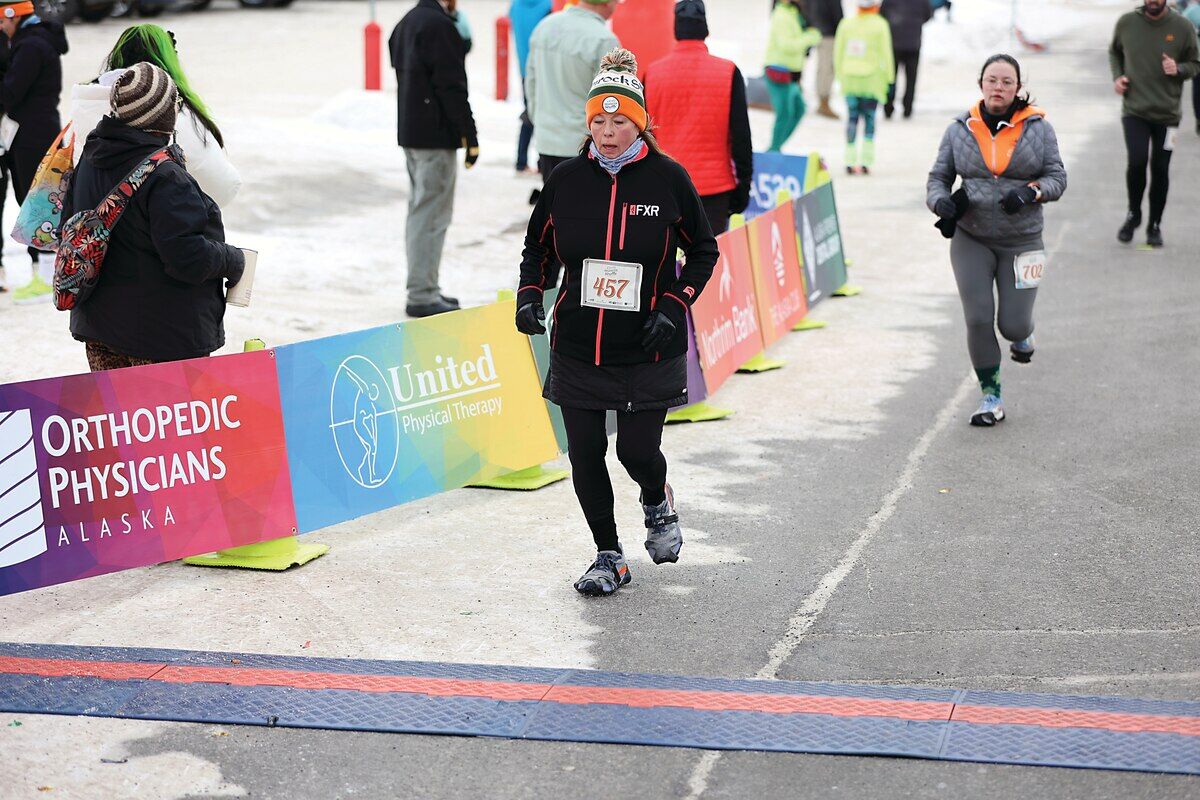

Katie Chadwick got the idea last summer that she wanted to do the all-women Gold Nugget Triathlon, an event with origins in an early 1980s effort by moms to create sports opportunities for their daughters and other girls.
Katie had been on what she describes as a “health journey,” and saw the Gold Nugget as an opportunity to demonstrate how she had become stronger and leaner. Her 60th birthday was coming up, and she wanted to set a goal to mark the moment.
“I just had this idea that I wanted to do the Gold Nugget,” Katie said. “It’s something I have no experience in. I have never done something like this.”
The Gold Nugget Triathlon is hard to describe. It’s not merely a race. It’s a transformative event where all kinds of girls and women, from Olympians like Kikkan Randall, to 10-year-olds on mountain bikes too big for them, tough it out together. It’s also one of the most singularly uplifting spectacles to behold because the women who are swimming, biking and running are all shapes and sizes, all ages and at all levels of fitness. They are rooting for one another and supporting one another on a demanding course. Their husbands, sons, brothers, and uncles are also there volunteering and cheering them on.
A magical event
The origins of the race are just as magical. A group of women organized the first Gold Nugget Triathlon (though it wasn’t called that at first) for their daughters and other girls to make sure they had opportunities to participate in sports. And it has grown from that first event in 1982. It’s considered the first women-only triathlon in the country and one of largest in the country, with about 1,700 women competing it every year both in-person and virtually.
“It’s not a race, it’s an event,” said Judy Sedwick, who dreamed up the idea of a triathlon for girls. She was part of the last generation of girls who didn’t grow up under Title IX, the sweeping 1972 civil rights law that prohibits sex-based discrimination in any education program or activity receiving federal financial assistance. The law transformed the experience of girls and women in public schools and higher education in admissions, academics and athletics.
Judy, who grew up in Anchorage, attended an all-girls school out of state. There, girls competed in sports with each other.
“For a lot of women, it’s an awakening,” Judy said. “They don’t see themselves as athletes, not initially.”
Her friend, Diane Barnett, was there at the beginning too. She got involved early on as an organizer and is one of the few people who have done every Gold Nugget since it started.
“It just kept getting bigger and bigger,” Barnett said. “It’s so hard to believe given all the races that have come and gone.”
Judy, Diane and many others who were there at the inception of the Gold Nugget will be there on May 17 and on many days before that giving their time to this labor of love.
What it takes
The Gold Nugget demands participants complete a 400-meter swim, a 12-mile bike leg, and a 3.25-mile running leg, mostly on an unpaved road that occasionally features a bear or two.
Some women, like Katie, train for a year; some train less. Diane, who is also on the board of the Gold Nugget Triathlon, Inc., is a devoted participant. Last year, at age 80, she won the 80-84 age division. In the 85+ age group, Millie Spezialy cruised to victory last year as the only one in that division. She’s been training this spring for it.
Katie is inspired by such people. What’s kept her going is the support she has received from others. For example, she chatted with a 71-year-old woman at the Shamrock Shuffle race in March who also got into running later in life.
Katie, who owns a salon/spa with her daughter, says she has received a lot of support from her clients, including one who gave her a bicycle. Her husband tuned it up and added glitter to it. She hears encouraging messages when she goes to her technique swim sessions as well. And when she attended a clinic at Skinny Raven about the equipment needs, the support continued.
“The camaraderie that was going on that night was just amazing,” Katie said. “It’s a community.”
Think you can’t finish a triathlon? Think again.
If you want to go from couch potato to triathlete, it’s an attainable goal. Alaska has a lot of support for people looking to get into the sport or wanting to improve their fitness.
To participate in next year’s Gold Nugget Triathlon, know that race signup is the first week of March and the race is in mid-May. It usually sells out, so be ready with fast fingers the evening the race opens.
To prepare for a triathlon takes planning and, ideally, some basic fitness level. Even the ability to walk a few miles will help. The Alaska Triathlon Club is a good place to learn about the sport and find training groups. https://www.alaskatriathlon.org/
To learn how to swim or become a better swimmer, there are options. One of them is Multisport Training of Alaska. Coaches Lisa Keller and Larrell Paterna have probably trained thousands of people by now, including a lot of newbies. Multisport features basic swim classes and technique classes so you can refine your stroke. Coaches dedicate a lane to beginning swimmers. To learn how to run or get better as a runner, Skinny Raven has training groups. https://skinnyraven.com/run-groups/ But many other running groups of differing abilities exist in Anchorage and elsewhere in the state. The Anchorage Running Club has a list: Arctic Bicycle Club is the place to start if you want to become a better cyclist, though many of the bike shops around the state also organize rides and can give you guidance. The Gold Nugget organizers also organize clinics that can help you improve your readiness in the weeks leading up to the event.