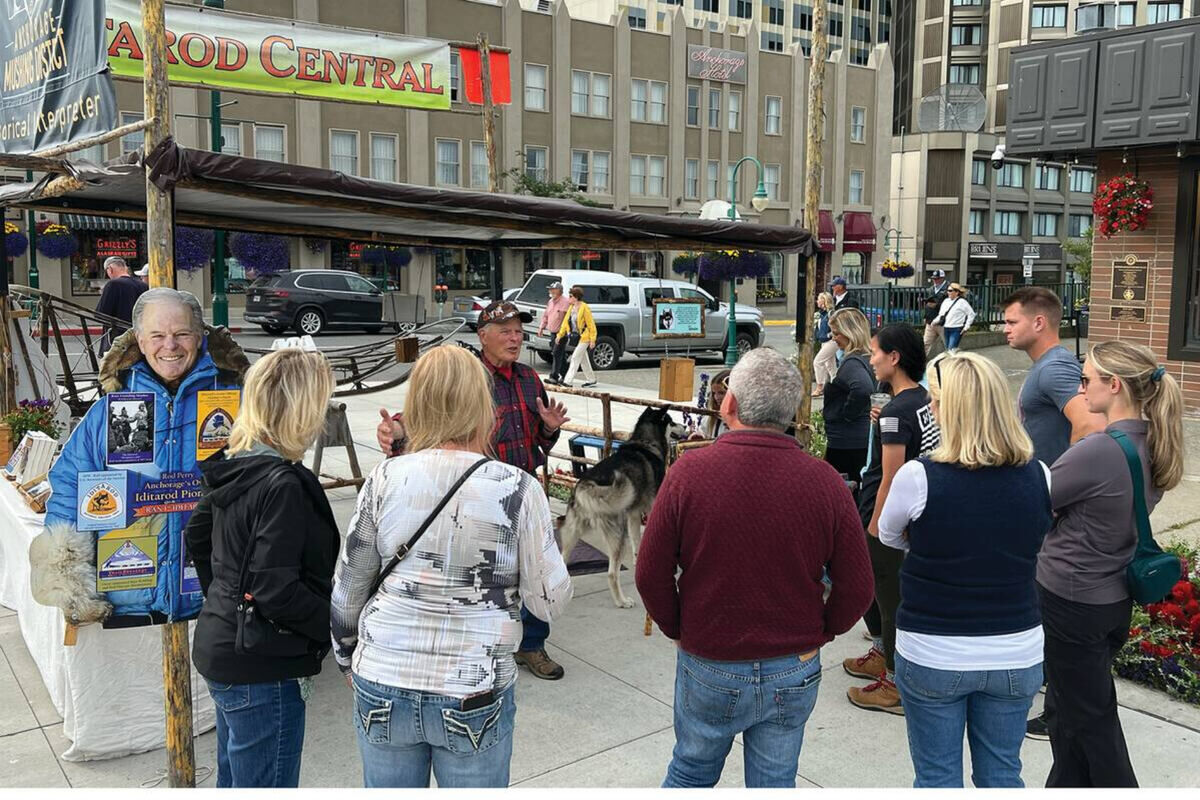

Perry, a former Dimond High School volunteer wrestling coach, raced in the first Iditarod Trail Sled Dog Race in 1973, 1974 and 1977. Since 2009, he has told the story about the Iditarod at a kiosk on Fourth Avenue in Anchorage.
This year's Fur Rondy will be different in that there is now an Anchorage Mushing District arch over Fourth Avenue, marking the starting line for the Fur Rendezvous Open World Championship Sled Dog Race and the Iditarod Trail Sled Dog Race, the state's most famous international event.
The landmark was inaugurated in November 2025, and it was the culmination of a multi-year effort by led by Jim Huettl, the president of the nonprofit Anchorage Mushing District.
"He was indefatigable," said Rod Perry to the Alaska Prospectors Society meeting on Jan. 20. Huettl fought administrative red tape, apathy, codes, and regulations in the 12-year effort.
Perry is on the Anchorage Mushing District Board of Directors and is the mushing district's historical interpreter.
For years, he has been holding court at a kiosk on Fourth Avenue, talking to tourists and residents alike about the history of mushing. He estimates he has talked to or button-holed about 100,000 individuals since 2009 to share the history.
Over three meetings this winter, Perry has explained the origins of the Iditarod Trail Sled Dog Race, a history that he says is "so outlandish, so absurd, so heroic..."
Clad in a red plaid shirt, his wrestling coach physique still compact and energetic at 83, Perry is a mesmerizing storyteller.
He held forth for about 90 minutes without slides or images about a history that included homesteaders such as Joe Redington, and friends such as Gleo Huyck and Tom Johnson, who helped organize the first race. The organizers also had a friend in Gen. Charles Gettys, then the commander of U.S. Army Alaska, who dispatched soldiers of the 172nd Arctic Light Infantry Brigade on snowmachines to test the machines' potential in Arctic combat on the original gold rush route, which became the route of the inaugural Iditarod Trail Sled Dog Race.
One of the most interesting aspects of Perry's story was that snowmachines had in the 1960s almost completely brought about the disappearance of the sled dog for virtually every Bush household, which had used them for hauling of firewood and water and much of the whole array of subsistence activities plus other travel and transport.
"Snowmachines changed so much and with such suddenness that it was staggering," Perry said.
The founders of Alaska's most iconic race had three goals: to hold a long-distance sled dog race, to use it to save the working sled dog, and to raise awareness of the Iditarod Trail pursuant to getting it included in the National Trails System.
Perry is emphatic that no other word is more closely associated with Alaska than the word Iditarod, and that of the thousands of people who stop by his Iditarod Central kiosk every summer, only a few have never heard the term.
Perry was a finisher in the inaugural Iditarod Trail Sled Dog Race in 1973, again in 1974 and 1977. He can delight a room-or a sidewalk-full of people about the characters behind the iconic race. There is no doubt that Alaska (and surprisingly, the wide-open nature of Anchorage in the mid-20th century) are formidable characters themselves in his storytelling.
To learn about the Iditarod, which has its ceremonial start in Anchorage on March 7 and its official start in Willow on March 8, from Perry's perspective, he has two books about the subject.