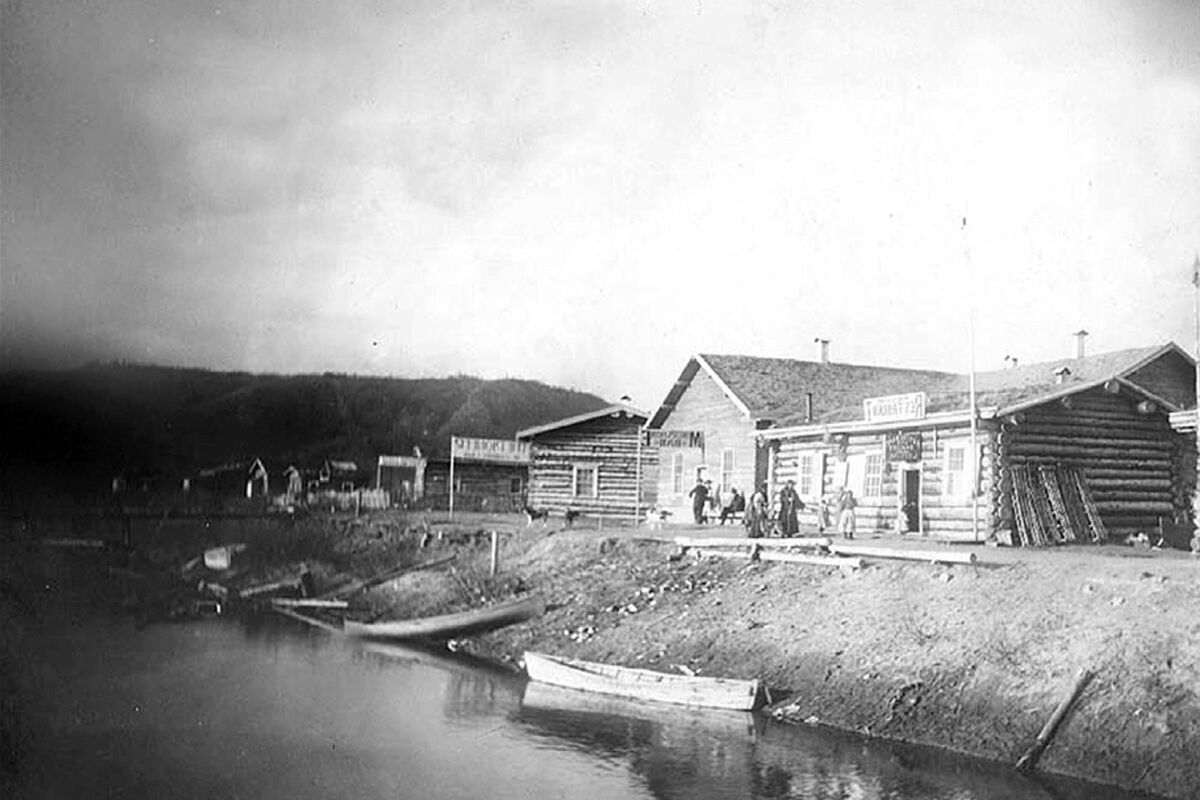

While bartending at Fortymile, seen here, Clarence Berry heard firsthand from George Washington Carmack about the riches in Bonanza Creek.
A few years before he became "the luckiest man on the Klondike," Clarence Berry was almost broke. He was a fruit farmer in California's Fresno Valley in the early 1890s, scraping by and struggling with the fallout from the Panic of 1893. He didn't have enough money to pay his room rent, let alone marry his sweetheart, Ethel Bush. When he heard wild stories of gold being discovered in the far North, he figured he had nothing to lose.
Borrowing what little money he could, Clarence set off for Alaska in 1894. He joined a group of 40 men to trek across the tough Chilkoot Pass, but thanks to his strength and stubbornness, he was one of just three who made it to the Fortymile mining camp. But he didn't strike it rich right away. Instead, he worked odd jobs, including tending bar to pay for food and supplies.
But Clarence didn't give up. He earned enough to travel home to California to marry Ethel and bring her back north with him.
For their "honeymoon," Ethel braved a three-month, 900-mile journey by sled dog from Juneau to Fortymile, with a trousseau made for Alaska winters: heavy wool, furs, and flannel. In an interview reported by John W. Leonard in Gold Fields of the Klondike, Ethel said:
"What advice would I give to a woman about going to Alaska? Why, to stay away, of course. It's no place for a woman. I mean for a woman alone...it's much better for a man, though, if he has a wife along...."
In 1896, luck finally smiled on the Berrys. While bartending for Bill McPhee, news of George Washington Carmack's big gold strike on Bonanza Creek changed their fortunes. McPhee grubstaked Clarence, who then staked a claim on Bonanza Creek and later traded his Bonanza claim for a key spot on Eldorado Creek with a fellow prospector.
For months, he and his partner toiled through frozen ground, but when they finally hit bedrock, they found the richest pay dirt anyone had ever seen. Suddenly, Berry was pulling in more gold than he ever dreamed-around $1 million in less than a year (more than $38 million in 2026 dollars).
The couple went "Outside" in 1897, boarding the Excelsior loaded down with suitcases and wooden boxes stuffed with gold. Crowds in San Francisco and Seattle swarmed the docks, desperate for a glimpse of the Klondikers and their piles of nuggets. The frenzy announced the start of the Klondike Gold Rush.
Most people lost their gold just as fast as they found it. But Clarence invested wisely and returned for a second round of mining in Alaska, striking it rich again in Fairbanks. The Berry family turned their wealth into a fortune in California oil fields, founding what became the Berry Petroleum Company-a business that still operates generations later.
Clarence was always grateful for the people who'd helped him along the way. He never forgot the saloonkeeper, Bill McPhee, who'd given him a crucial stake early on and later supported McPhee through hard times. Both Clarence and Ethel became legends-the adventurous, modest millionaires who showed the grit and generosity that marked the best of the gold rush era.
Today, Berry's legacy lives on in Alaska, from university scholarships to a bronze plaque and "Gold Room" at the University of Alaska Fairbanks. He and Ethel proved it was possible to survive the wilds, find fortune, and keep their feet on the ground. Sometimes, Lady Luck rewards those who meet her halfway.
This column features stories researched for Aunt Phil's Trunk, a five-book Alaska history series written by Laurel Downing Bill and her late aunt, Phyllis Downing Carlson. Along with Bill's latest book, Pioneers From Alaska's Past, the books are available at bookstores and gift shops throughout Alaska, as well as online at www.auntphilstrunk.com and Amazon.