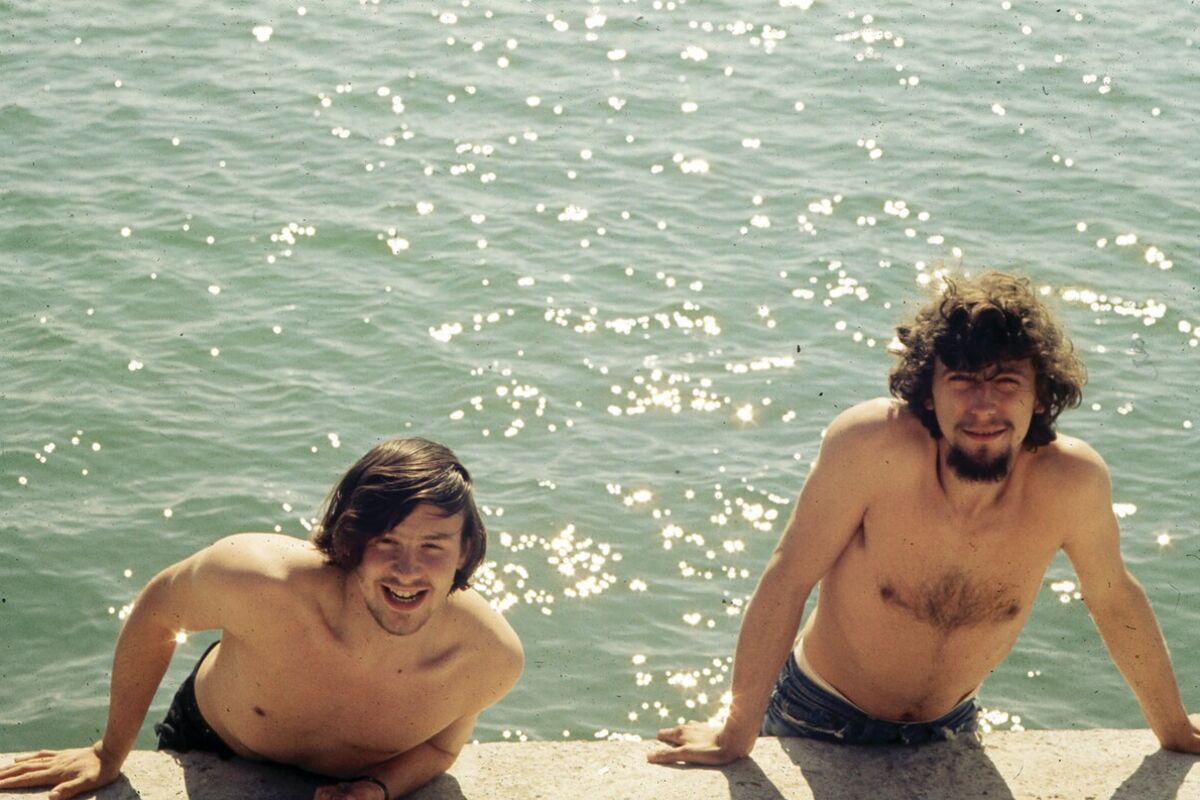

Mac Metcalfe and Jeff Prather took a swim when they got to Yugoslavia.
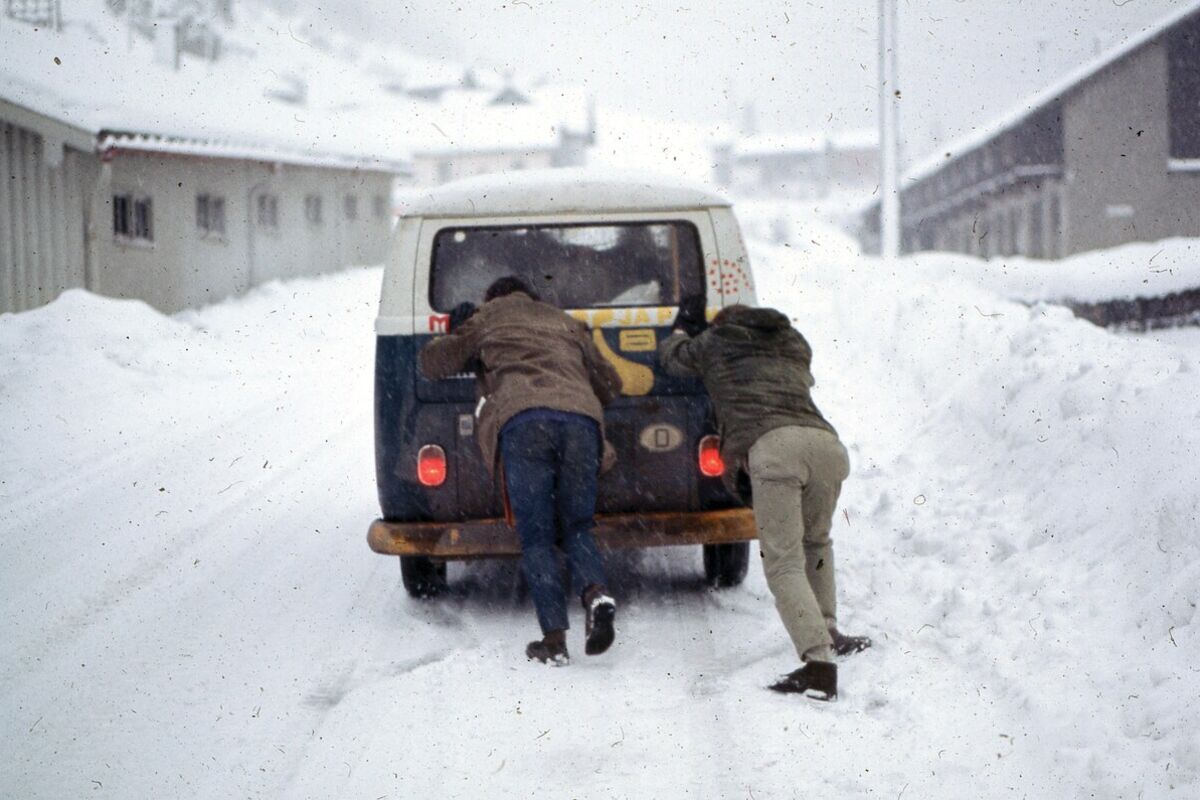
Mac and David push the Volkswagen van up a hill in the Alps. They weren't prepared for the snow and were happy when they got to Italy.
Top: Mac and David push the Volkswagen van up a hill in the Alps. They weren't prepared for the snow and were happy when they got to Italy. Mac Metcalfe and Jeff Prather took a swim when they got to Yugoslavia.David and Mac were World War II history buffs. They knew this was a German panzer.
Author Kim Metcalfe with Pappousi Yianni (or Grandfather John) in the village of Malia, Crete. He spoke a little English and liked to talk about how the soldiers and civilians fought the Germans during World War II.
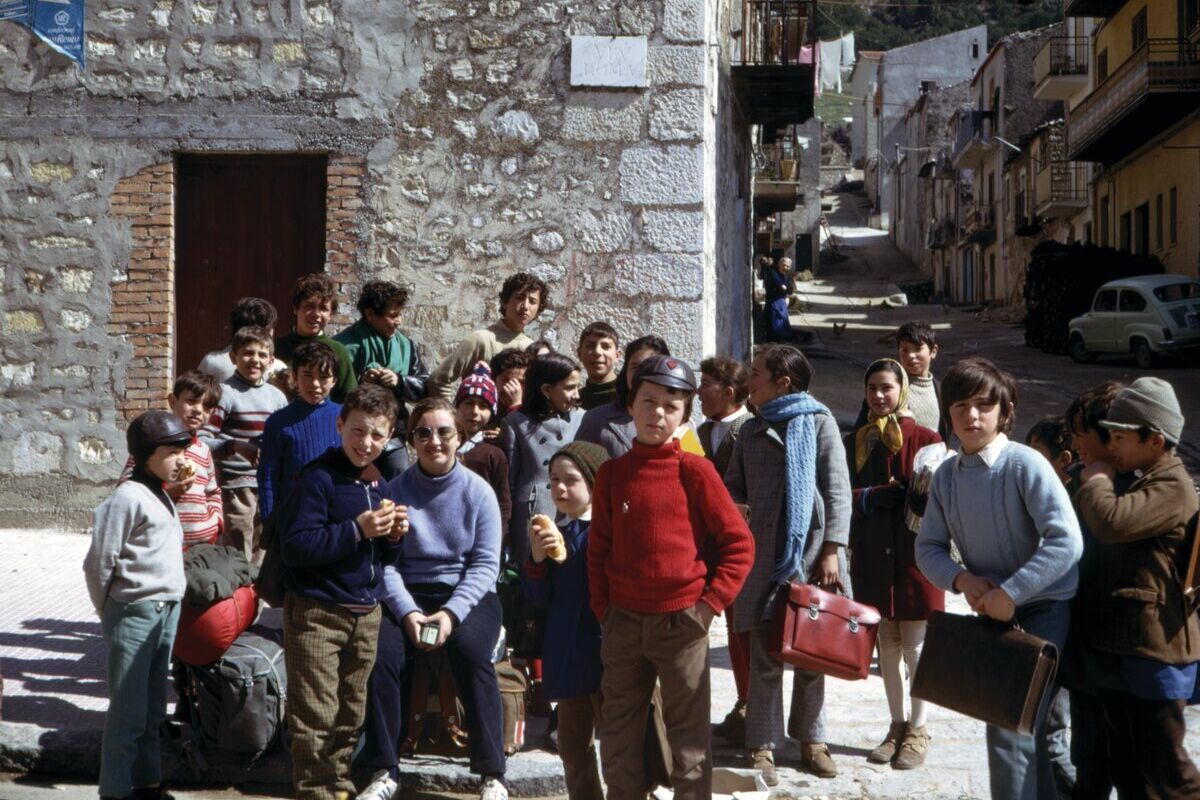
Carol, a Canadian Kim Metcalfe met on her travels, with Sicilian school children.
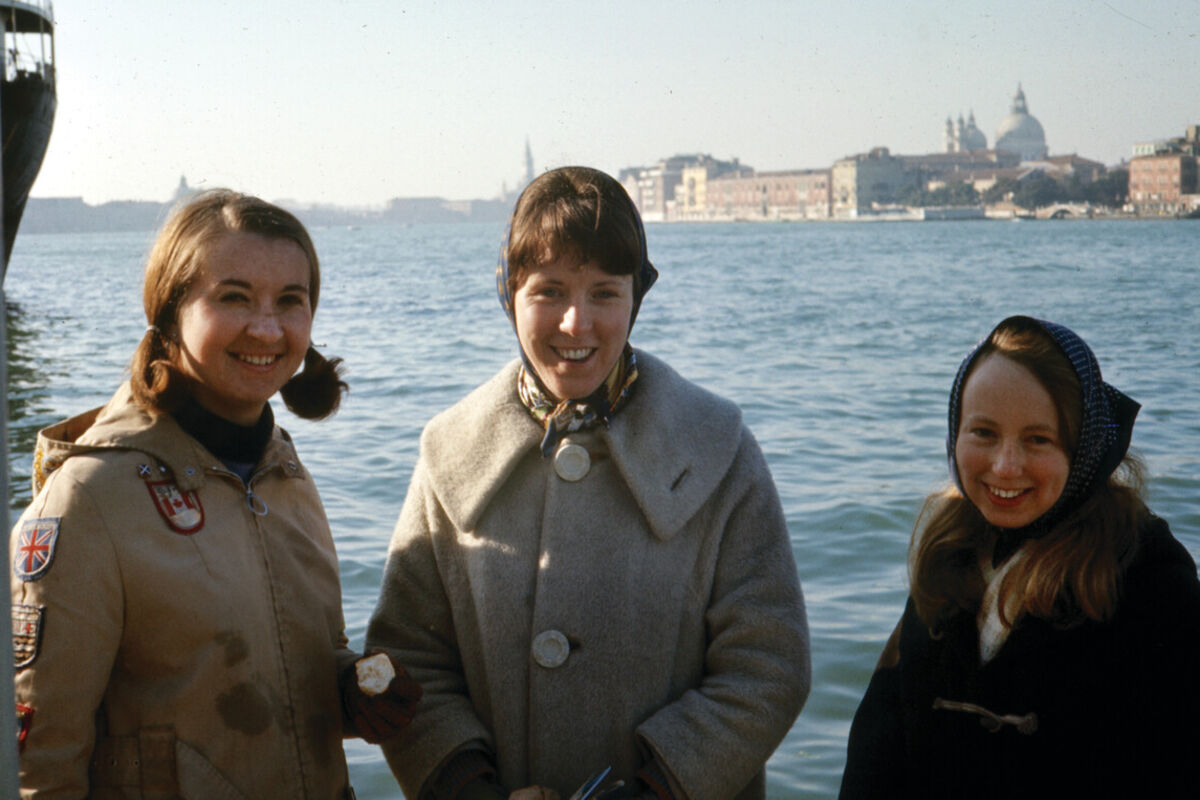
Carol, Marg, and Lois, all women people Kim Metcalfe met while traveling in Europe, in Venice, 1971.
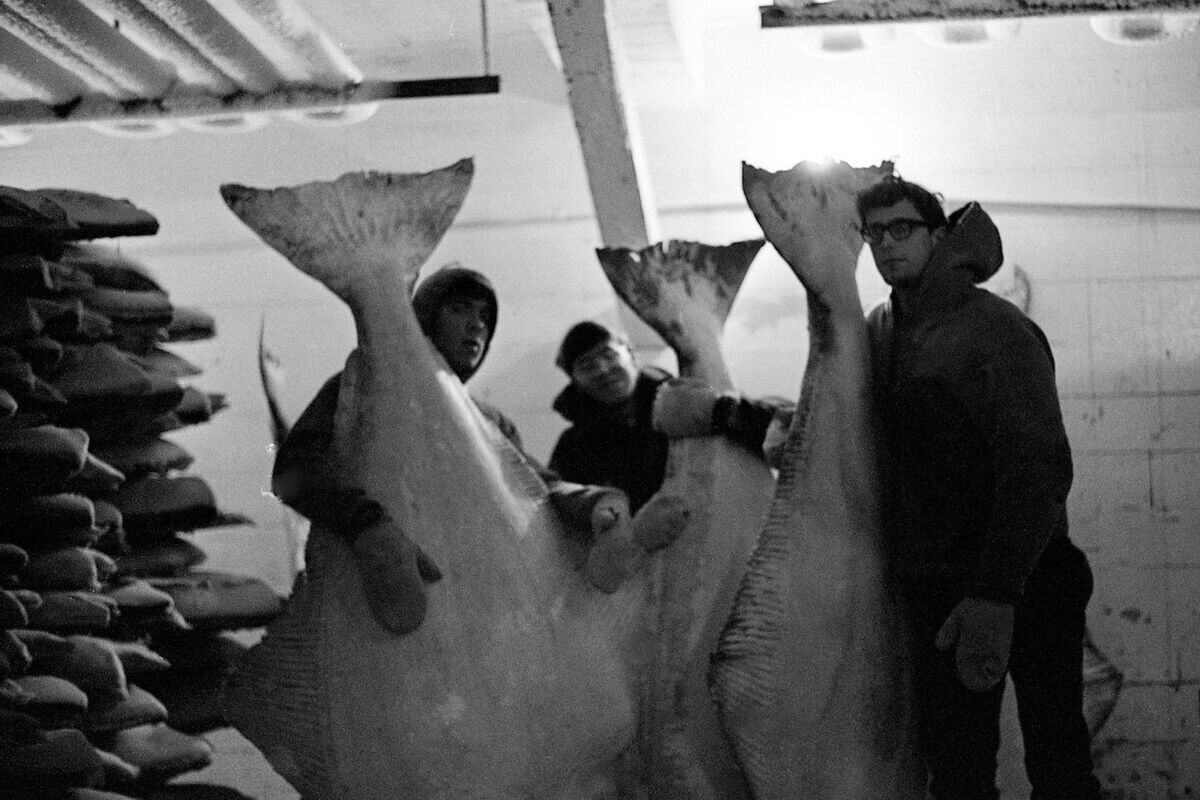
Cousins Pat Gullufsen, Mac Metcalfe, and Jeff Prather pose with large halibut in the freezers at the Juneau Cold Storage, a fish plant in Juneau. The Cold Storage closed in 1987 following a devastating fire.
Mac Metcalfe was back in Juneau in the spring of 1969, after serving a tour in Vietnam. He was one of the fortunate ones, having served as a teletype operator in relative safety just south of Saigon. Despite experiencing shelling and a night attack by sappers, he returned unharmed to Juneau. He picked up a job at the Juneau Cold Storage, a fish processing plant, where he and his cousins Jeff Prather and Patrick Gullufsen and a group of friends spent the summer months as the "inside crew." They worked in a part of the plant where fish were deep frozen and piled in stacks for shipment. It meant spending the summer inside huge, ice-fogged freezer rooms, but the money was excellent. It was a union job that paid well and there wasn't time to spend it.
After the season ended, Mac called his childhood friend, David Kenway, who was in college at Oregon State University in Corvallis. "Out of the blue, he called me at OSU at the end of the first term of my second year. He was back from Vietnam, out of the Army, and said he and Jeff were going on a trip around the world. Did I want to go? It sounded fun, and I had money saved. That's how quickly it came together."
The three met in Seattle in early January 1970, and after bar hopping in the big city, they made their way to Pullman, Washington, where they picked up a Drive-Away car. The vehicles were a frugal travel option that allowed drivers to pay for gas and deliver a car to the owner in another part of the country. Their destination was Albany, New York. They drove Interstate 90 in the dead of winter. On their way to the Little Bighorn National Monument, the weather went from snowy to a raging blizzard. They drove off the road and were fortunate to be rescued by a trucker who towed them out of a ditch. They were OK and the car wasn't damaged.
After brief stops to see Mount Rushmore, Jeff's college friends in Madison, Wisconsin, and relatives in Chicago, they delivered the car and were off to New York City to catch their flight on Icelandic Airlines (known then as the "Hippie Airlines" for its budget fares), to Luxembourg.
After separating for two weeks of travel on their own, they met up at the youth hostel in Amsterdam where they purchased a battered, colorfully painted Volkswagen van from three Japanese students. They realized later why the students seemed amused as they handed over the paperwork for the van.
"We got as far as the German border and were unceremoniously turned back. It happened that when the van was purchased years earlier it was good for six months in Europe and then had to be exported or the waived taxes had to be paid. The taxes were never paid, of course, and the van was sold and resold to unwary buyers like us," David said.
Being resourceful Alaskans, they devised a plan to look for small town border crossings, often waiting until nightfall to cross. Jeff talked their way through the Italian border by "playing dumb" until the utterly frustrated Italian border guard impatiently waved them through. Besides Italy, the three quietly slipped into Belgium, France, and Switzerland. The tax status issue was ignored in Yugoslavia, Greece, and Turkey. The van died in Turkey where they abandoned it. "Someone was grateful for the parts," Mac quipped.
The trio split up after Athens. David flew home around the world via Israel; Jeff returned to Alaska from Istanbul after the van died. Mac completed his round the world adventure, hitching, riding buses or trains through Turkey into Iran, Afghanistan, and Pakistan, ending up in India where he flew back to the U.S., briefly stopping in Vietnam to visit friends he made while stationed there.
Motivated by the travels of Mac, Jeff and David, I made plans to go to Europe. Juneau was isolated, but we were up on the latest news, reading newspapers and magazines and listening to news on the radio. In July 1968, Life magazine featured a spread titled, "The New Odyssey of American Youth: A Restless Generation Roams Abroad, Housekeeping in Caves in Crete and Keeping Home Far Away." A publication called "Europe on $5 a Day," was a guidebook for cheap travel on the continent. I wanted in on the action.
My friend Joan, who I worked with as a long-distance telephone operator, decided to go with me. We flew Icelandic Airlines to Glasgow, Scotland, where we purchased membership cards from the Scottish Youth Hostels Association. My card was issued on November 5, 1970, and its colorful stamps from hostels in Scotland, Ireland, England, Spain, France, Italy, and Greece show my progress across Europe. It was a time when thousands of American, Canadian, and Australian youths were hitchhiking with backpacks, or using Eurail passes to see the wonders of Europe.
Joan and I made it to the Scottish Highlands but were put off by the strict rules regarding women in pubs, and the judgmental stares we got from the rigid Scots. We heard from other travelers that Ireland was a lot more fun, so we crossed the Irish Sea by ferry to the Emerald Isle. Our first stop in Northern Ireland was at the port of Larne. It was late in the evening and we were tired. We knocked on the door of the first B&B we came across. A kind woman showed us our room and came back with cookies, hot chocolate, and hot water bottles to warm our beds-a great introduction to Ireland.
We made it as far as Cork, hitching from one town to the next, enjoying the pubs and Irish hospitality. The pubs were community gathering places where musicians played and everyone sang along to the tunes. We kept going and headed for London where Joan decided to stay on a bit longer. I took the ferry to Calais and got a ride as far as Paris. I was let out in the middle of the city, and everyone I tried to speak with ignored me. In 1970s Paris, the French had little use for someone who only knew English. I came across a train station and, frustrated with being unable to figure out Paris, grabbed the first train to Barcelona.
Barcelona was fun. Cheap wine, bars with incredible tapas, late-night dancing, and lots of young people. From Barcelona I hitchhiked through Spain, and across the Riviera into northern Italy where I met three Canadian women. I teamed up with Carol from Saskatchewan, and we hitched south to Florence, Rome, Naples, and the tip of "the boot," Reggio Calabria. We got rides in fancy sports cars and learned that stopping for coffee meant a quick shot of espresso, and zip!-back on the road.
From Calabria we crossed the Strait of Messina to Sicily. It was spring and the almond trees were blooming in Taormina, an incredible mountainside town. From Taormina we could see Mount Etna, an active volcano. At night bright red flames lit up the sky directly across from the Greek amphitheater where we watched the show. Carol talked me into going to Corleone, the Mafia stronghold we learned about from the newly released book, "The Godfather." I thought the town was fictional, but it was real, perched on the side of a hill.
From Sicily, we headed for Greece. We ended up on the island of Crete after spending time on Corfu and in Athens. Because I spoke English and was almost broke, I landed a job in a tourist shop in Heraklion, Crete's largest city, where I worked for a month until the police came by to check out my work papers. No papers? No work. I moved to the village of Malia, on the Mediterranean Sea, and spent the next three months savoring amazing Greek food chosen from cooking pots in the taverna kitchens. I hung out with young Americans and British travelers on the beach and got the best tan of my life.
My money finally ran out, and it was time to go home. Ten months on the road. What an education. I saw the great capitals, small towns and villages of Europe, saw famous works of art, ate in bistros, cafes and tavernas. We were young and navigated with paper maps, and left notes for friends on bulletin boards to let them know where we were headed. We stayed in B&Bs, youth hostels, and pensions with no prior reservations. There were different currencies and languages in every country, and somehow, we survived. As the Simon & Garfunkel song of that era, "Bookends," goes:
Time it was, and what a time it was, it was
A time of innocence
A time of confidences
Long ago, it must be
I have a photograph
Preserve your memories
They're all that's left you
Kim Metcalfe and her brother, Mac Metcalfe, were born and raised in Juneau and still live there. David Kenway was raised in Juneau and lives in Utah. Jeff Prather, a cousin of Kim and Mac's, was also born and raised in Juneau and was raised in the same house as the Metcalfes. He died in 2021.